
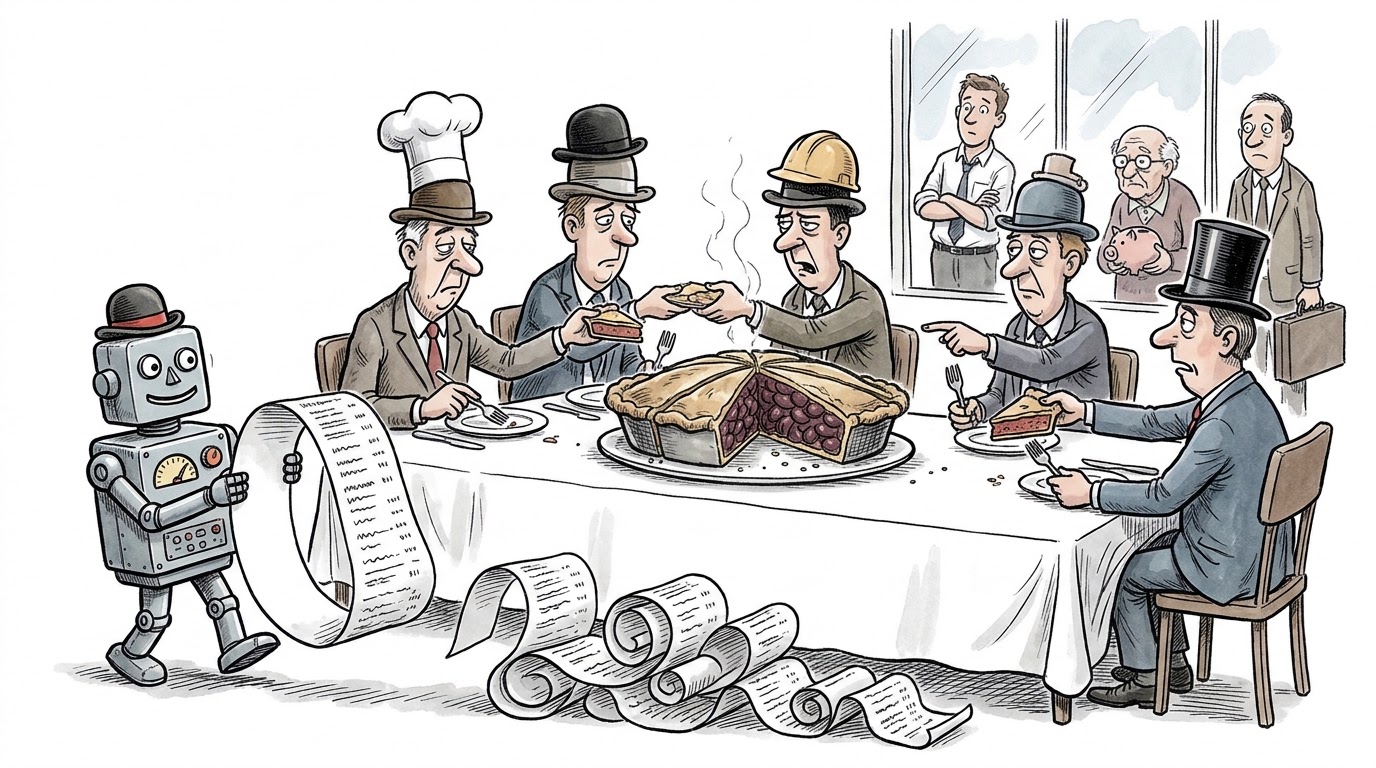
In a conversation with a family member yesterday, the verdict was (my words, not theirs): it's all hot air, statistical models for people who can't be bothered to google an apple pie recipe themselves, and who are then told by their AI assistant to buy their apples at the local butcher. So what is a listing worth well over a trillion dollars even about? I think that picture says something real. Outside the corporate world most people know AI mainly from ChatGPT, usually the free version, which still regularly serves them a confident invention instead of the truth, and as far as I can see that doesn't do much for public trust in how reliable these tools are. I don't share that view, because in my working life I see things changing that are very real. But I do take the signal seriously, since it is the same one my timeline sends me every day, only with more graphs and a cliff at the end. Making sense of those stories, and of which dynamics are actually at play, is why I started this series in the first place.
On Tuesday I wrote that Anthropic's prospectus talked me out of the empty dot-com shell my timeline keeps promising me. It still left two places where I see traits that probably can't last: the commitments in the filing, and the question of how customers earn their money back. What I left out is that two weeks earlier Anthropic had already told prospective investors that its third-quarter revenue was 16.8 billion dollars, up 45% on the quarter before. By any normal standard that is an extraordinary quarter. By the standard its valuation sets, it was a slowdown. Within a day some investors were reportedly discussing a valuation of 1.5 trillion instead of the 2 trillion they had expected.
Today, in its Saturday issue, NRC laid out the web of interests around the listing in more detail than I had, and I went through the sources behind that article. The question I ended up with is not whether investing in Anthropic is a good idea (I'll leave that up to you). The question is who carries the risk if growth slows down and the bills for spending committed earlier start to come in.
Customer, supplier, shareholder and competitor
The part that struck me most is how often the same three names come back in different roles. In the first half of this year 48% of Anthropic's revenue came in through the clouds of Amazon, Google and Microsoft, up from 11% in 2023. The customer pays its cloud provider, which keeps a fee and passes the rest on. The same three sell Anthropic its compute, with minimum commitments of 114.5 billion dollars to Google through 2033, 110 billion to Amazon through 2036 and 44.9 billion to Microsoft, whether that capacity is used or not. Google and Amazon are also shareholders (by Bloomberg's count at least 6.6% and roughly 9%, with caps of 14.99% and 12% that they can waive). And all three build models that compete with Claude. The prospectus itself says this "creates complex dynamics that could give rise to conflicts of interest".
Jon Stewart, hearing all this on his podcast The Weekly Show this week, put it less politely than I would: "Is this all just a circle jerk?" A little later he reached for an episode of Beavis and Butt-Head in which the two of them have one dollar and a box of chocolate bars to sell for a school fundraiser. They keep buying each other's bars with the same dollar, and by the end the chocolate is gone and they still have one dollar. His guest Ed Zitron added the part that matters: "That's basically it, except NVIDIA gets the real dollars."
This week showed that such stakes cut both ways. Alphabet marks its stake in SpaceX at fair value every quarter. In the third quarter that produced a loss of 8.2 billion dollars, its first earnings miss in almost four years and a share price down some 10% after hours. In the second quarter the same accounting rule had given it a paper gain of around 98 billion. Once Anthropic is listed, its share price will probably move Google's and Amazon's earnings in the same way, in both directions.
Who pays for the big pie
The structure underneath is the maturity mismatch I mentioned on Tuesday. At the end of June Anthropic had about 265.6 billion dollars in fixed or minimum commitments. According to NRC it expects to need 750 to 800 billion dollars of compute through 2030. Many of its customer contracts, meanwhile, can be reduced or ended at short notice. Demand doesn't even have to fall for that to hurt. It is enough for revenue to grow more slowly than the commitments ramp up. In the third quarter revenue grew by 5.2 billion dollars, against 6.9 billion the quarter before.
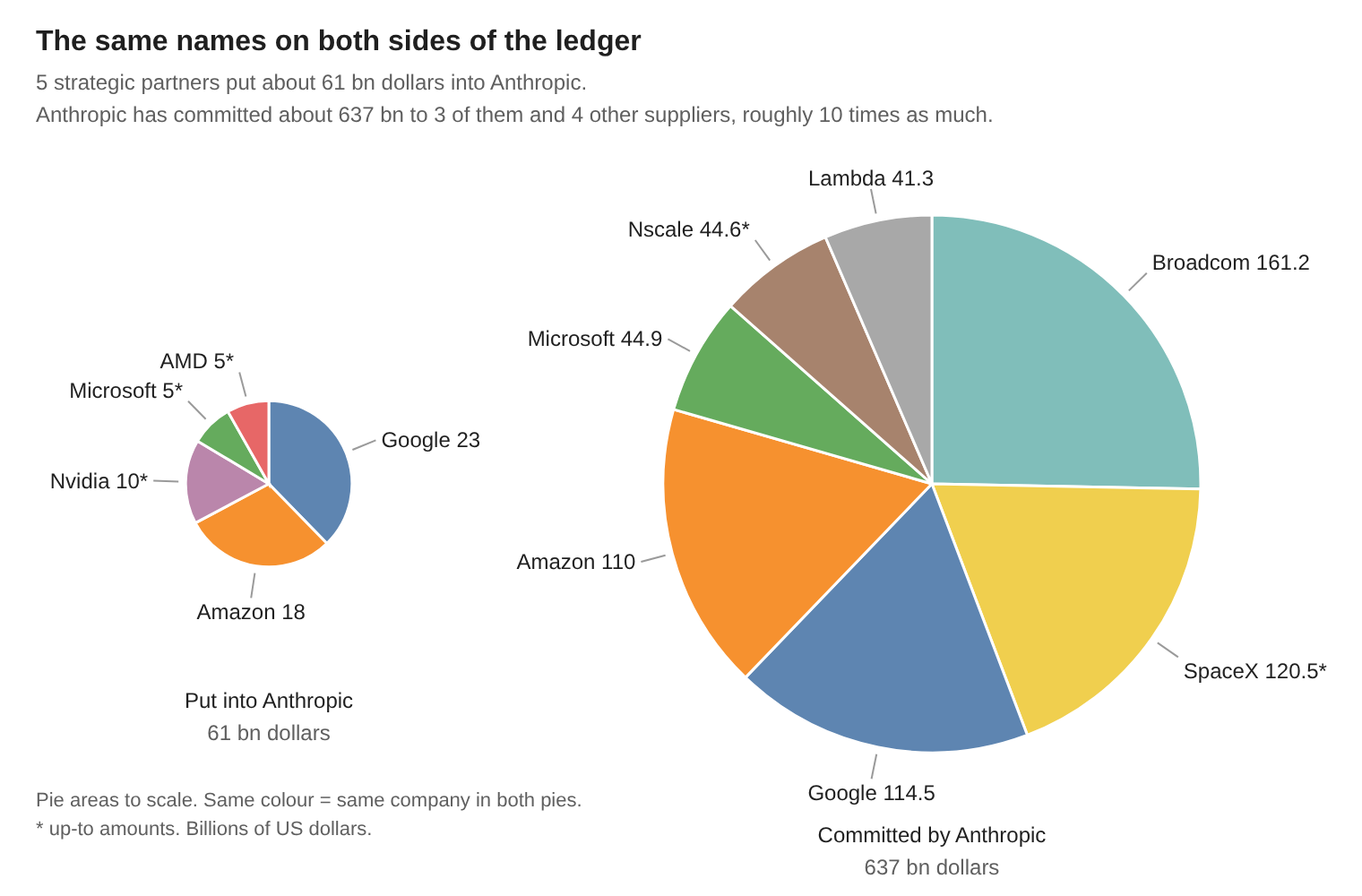
Sources: Invested: Google and Amazon per Bloomberg via Business Standard; Nvidia, Microsoft and AMD as announced (up to). Committed: Anthropic S-1, pp. 171-172.
Drawn to scale, the two pies make the point better than the numbers do: what the partners put in is a small pie next to what Anthropic has promised to pay, and much of it goes back to the same companies.
What I hadn't realised is how much of the bill is being guaranteed by the suppliers themselves. Broadcom is behind a 63 billion dollar deal in which a separate company borrows money to buy chips that Anthropic then leases. If Anthropic stops paying and the chips are worth less than the loan, Broadcom absorbs the loss on roughly 43.5 billion of senior debt. According to The Wall Street Journal several banks considered pulling out. The deal only closed after Broadcom's chief executive Hock Tan intervened personally and accepted a higher interest rate and stronger protections for the lenders. Two weeks earlier he had said that "the biggest constraint is capital". And Nvidia is reportedly in talks to give billions of dollars in credit guarantees for an Nscale data centre in West Virginia that Anthropic will use. So the chip makers guarantee the debt that pays for their own chips, for a customer whose revenue still has to catch up. I'd say the lenders who hesitated are the ones with the clearest view of that risk. And in the four days since my last piece the signals kept coming. On 30 October Alphabet lost nearly 13% of its value, its worst day ever. Its search revenue grew more slowly than analysts expected, while the number of queries grew at its fastest in five years, because answers in its AI Mode earn less than ordinary search results. Its free cash flow was negative for the second quarter in a row. The same week OpenAI was reported to have raised only about 11 of the 30 billion dollars it was looking for. None of this is a crack yet, but the money is clearly getting more careful, in the very month Anthropic needs it.
If the gap does open, my guess is that the damage moves roughly in this order. First come the largest customers, which as far as I can tell include several venture-funded startups (the prospectus shows how concentrated that spending is, see the pie below). Next is Anthropic itself, which has a buffer and will have a bigger one after the listing. After that come the landlords who borrowed against its contracts, and their lenders in private credit and insurance. Then the earnings of the cloud providers take the hit, and finally the chip makers' order books. Banks sit further out than in 2008, which makes this look more like 2000 to me than like a financial crisis. Part of the risk also moves to whoever buys the shares in November. For now they get a prospectus in which the third quarter is still blank, while professional investors heard those numbers two weeks ago.
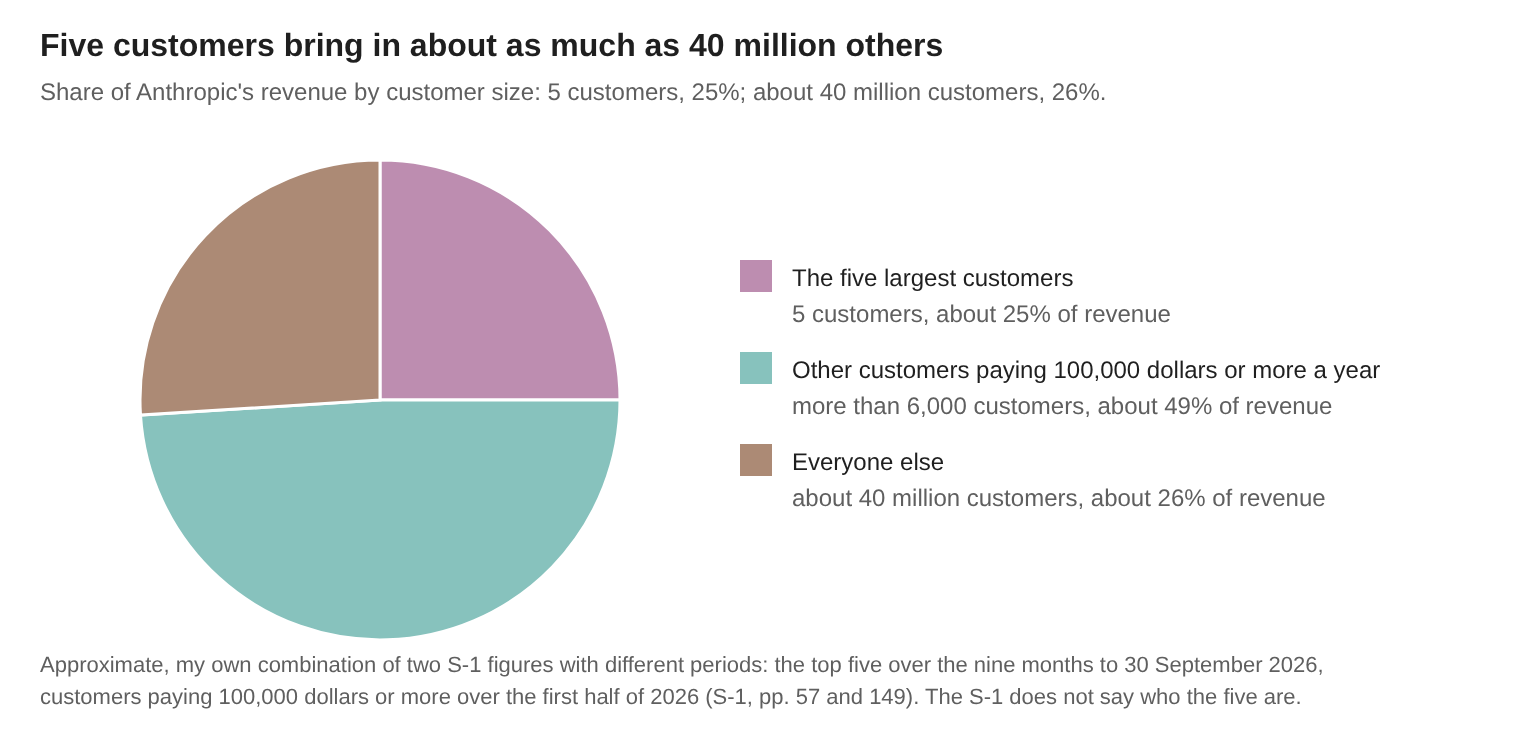
Sources: Anthropic S-1: top five customers p. 57, customers paying 100,000 dollars or more p. 149. The combination of periods and the 49% are my own arithmetic.
That concentration is falling quickly, though: according to the prospectus the top five accounted for about 36% of revenue in the first quarter and about 21% in the third.
What the prospectus doesn't show is how much compute each of these groups costs. The largest customers probably buy at a volume discount, and some heavy subscribers use more than they pay for, so I'd expect this is where profitable and unprofitable revenue part ways.
What all that compute is actually for
Which brings me back to the question underneath all of this: what is the compute used for that makes money today? A large part goes to the race itself. Epoch AI's estimate for OpenAI in 2024, in the pies below, shows that most of the compute went to research and experiments. Much of it did not even go to the final training of models OpenAI released. A rough split from Anthropic's own filing lands in almost the same place, with about a quarter of its compute serving paying customers. OpenAI's leaked accounts for 2025 point the same way, with 19.2 billion dollars of research and development against 7.5 billion of cost of revenue, although research and development also includes salaries and stock pay, so it is not all compute. A lot of the serving is probably free, given how many people use the free versions. Where people do pay, coding is, as far as I can tell, the largest proven use. The most convincing return on AI compute I could find isn't a chatbot at all. Meta's advertising revenue grew 33% in the first quarter, with the price per ad up 12%, and Meta credits its AI ranking models for part of that.
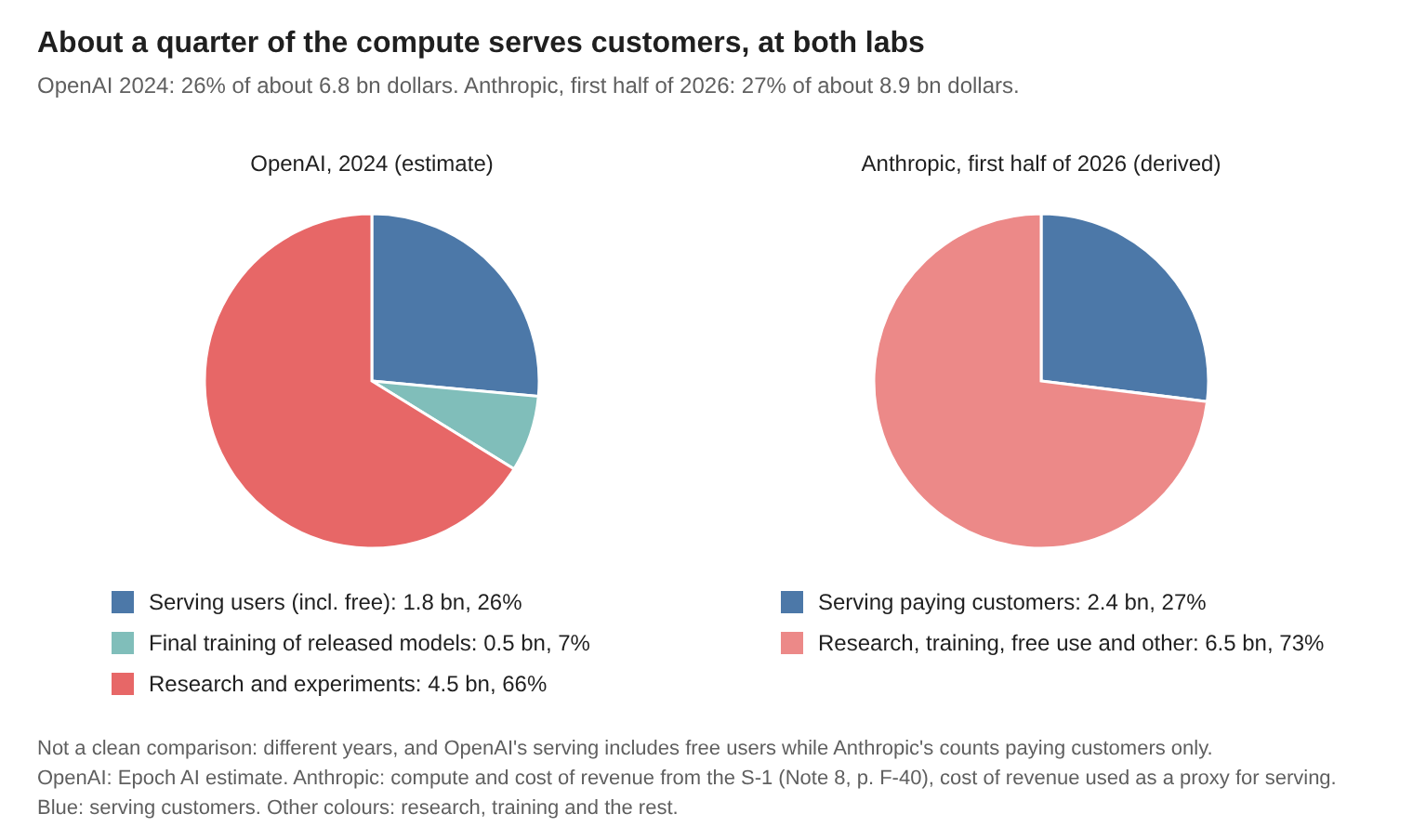
Sources: OpenAI 2024: Epoch AI estimate. Anthropic H1 2026: compute and infrastructure 8,945 million (S-1, summary financial data) and cost of revenue 2,380 million (S-1, Note 8, p. F-40).
Coding on its own probably can't carry the commitments. There are about 20 million professional developers worldwide. Put their wage bill at roughly a trillion dollars a year. Assume AI takes over a quarter of their work and its suppliers capture about a third of that value. My own rough sum then ends at something like 70 to 100 billion dollars a year for all AI suppliers together, which is about the size of one lab's commitments. Code is also the one domain where output can be checked automatically, and that is where cheaper models catch up fastest. One well-known coding agent cut its starting price from 500 to 20 dollars a month, which probably makes the biggest paid market also the one most exposed to price pressure.
What I see from where I sit
The commitments assume that agents will take over a large part of the administrative and analytical work in offices. That is where my own view comes in. In the banking group I work for, people are being let go in reorganisations, many of them from manual, repetitive administrative work. But what I see replacing them is mostly not AI. Part of the work is absorbed by colleagues and simpler processes. The rest moves to central departments that will do it for the whole group. There is a lot of experimenting with AI, and as far as I can see no large-scale use of it yet. A large insurer nearby is more outspoken and says it needs fewer people in its back office because of AI, which I believe, although I can't check it.
Put together, I'd say these are two steps of the same sequence. First you consolidate and standardise the work, then you automate it, because AI needs a central, standardised process to work reliably. If that is right, the jobs disappear first and the AI revenue from organisations like these arrives later, while Anthropic's commitments ramp up now.
And there is a limit I run into in my own work. AI helps me understand problems faster and spend less time on steering documents and reports, and I'm happy to use it for that. But the pace of a migration in which three organisations have to align is set by decisions, dependencies and waiting for each other. AI doesn't change much there. I suspect that is a large part of why the gains show up in individual tasks and not yet in the economy as a whole.
So this is my own thesis. I think the big steps are possible, provided you find a way to make the technology controlled, reliable, repeatable and scalable inside organisations like these. We are not there yet. The effort it takes to get there hasn't been priced into any of the optimistic pictures I see. I'd say it is the same problem my family member ran into with the apple pie: an answer that sounds certain and isn't. A consumer can shrug and google the recipe after all, but inside a bank or an insurer someone has to solve that problem, and pay for solving it, before the results can be trusted at scale. On Tuesday I described how the bank I worked for in the early 2000s outsourced its IT to large Indian providers: the cost of a single hour dropped dramatically, the total number of hours went up, and soon there was a layer of people in the Netherlands directing and checking the work, which is the kind of cost I see missing now.
Economists have a name for it, complementary investment: the redesigned processes, training, oversight and new roles a technology needs before it pays off. Brynjolfsson, Rock and Syverson argue that these investments are large enough to make measured productivity dip before it rises. The classic example is electricity, where factories only rebuilt themselves around the electric motor decades after the first power stations. If AI follows that pattern, the payoff will probably arrive later than the commitments fall due.
What I'm still chewing on
In a landscape where the algorithm pushes the pessimists onto my social media timeline, it's hard to decide who to believe. As usual, my feelings about this are mixed. Ed Zitron, a guest in that Weekly Show podcast episode, makes a fair point: a lot of the money does go round in circles, and the commitments are real. But he pulls the picture further towards the negative than the numbers allow. He put Anthropic's yearly revenue at 30 to 50 billion dollars at most, while the third quarter alone was 16.8 billion, and he said the company only loses money, while the prospectus shows an operating profit of 974 million dollars in the second quarter. I nearly went along with his framing anyway, because it fitted what my timeline had been telling me for months.
So if I put the doom on my timeline next to the optimism in the prospectus, and check both against the numbers, I'd put it like this. I don't think it comes down to whether AI works, or even whether Anthropic can sell it at a profit. What matters is whether paying demand grows fast enough to keep up with commitments that start now, and who ends up paying if it doesn't. I don't know the answer, and I suspect nobody inside the company does either, or anyone else in this landscape. That, in essence, is the gamble we are looking at.
What I can't work out is whether that cost of control is the normal stage every new technology goes through, or the thing that makes this boom come down. It could be the latter if control turns out harder than expected: so expensive that the results stop paying, use grows more slowly, and the extra compute sits idle while the commitments keep running.
Can that gamble be turned into a certainty? I don't think so, and I'm not even sure that's the right thing to want. Nobody can know in advance whether control will get cheap enough in time, so the best I can do is watch the few things that will tell me which way it is going. Does paying revenue keep growing in dollars, and not just in percentages, as fast as the commitments ramp up? Does AI move from pilots into production in the parts of organisations that don't write code, where the checking is hardest? Is the compute that has been bought actually being used, which you can probably read from what it costs to rent? And do lenders and investors keep showing up, or do they need ever more guarantees from the suppliers before they do? If those four start pointing the same way, in either direction, I'll know a lot more about which way this goes.
What I don't think we can do is get out from under it. With this much of the stock market riding on a handful of companies, most of us are part of this bet through our pensions and index funds, whether we chose to be or not. What we can choose is how much of it we carry ourselves. I made my own modest choice on that in July, and so far I see no reason to change it back. Maybe that is just how it is, at this point in the economy and in the technology: a bet you can't avoid, only size.
So, to those of you reading this: if you are trying to make AI work reliably and repeatably in your organisation, I'd like to know what that control is costing you, and whether anyone had put it in the business case. And if you have broader experiences in this field, good or bad, I'd love to hear about those too.
Sources
- Jan-Willem Rodenhuis, "I read Anthropic's prospectus and ended up thinking about outsourcing to India", miliarium.nl, 27 October 2026
- Jan-Willem Rodenhuis, "The algorithm has decided that I need to worry", miliarium.nl, July 2026
- Daan van Lent, "Heel Silicon Valley heeft belang bij slagen van beursgang Anthropic", NRC, 30 October 2026 (print edition 31 October)
- Anthropic, PBC, Form S-1, filed 26 October 2026: fixed or minimum commitments of ~265.6 billion at 30 June (p. F-59), customer contracts that can be reduced or ended at short notice (p. 43), top five customers about 25% of revenue (p. 57), "complex dynamics" (p. 74), top five at about 36% in Q1 and 21% in Q3 (p. 144), customers paying 100,000 dollars or more 74% of H1 revenue (p. 149), Q2 2026 operating income of 974 million (p. 158), named compute agreements (pp. 171-172), cost of revenue in H1 2026 (Note 8, p. F-40)
- Reuters, via Global Banking & Finance: Q3 revenue of 16.8 billion, up 45%; investors discussing ~1.5 trillion
- Business Standard: 48% of H1 revenue via cloud partners, stakes and caps per Bloomberg, minimum compute commitments
- TechTimes: Alphabet's 8.2 billion SpaceX loss in Q3 2026
- Yahoo Finance, citing The Wall Street Journal and Reuters: the 63 billion Broadcom deal, hesitant banks, Hock Tan's quote
- The Star, citing Reuters and The Information: Nvidia credit guarantees for Nscale
- The Next Web, citing The Wall Street Journal: up to 750 billion in compute spending
- Epoch AI: OpenAI's 2024 compute split
- PPC Land: Meta Q1 2026 results
- JetBrains Research: ~19.6 million professional developers in 2024
- Brynjolfsson, Rock and Syverson, "The Productivity J-Curve", American Economic Journal: Macroeconomics, 2021
- The Weekly Show with Jon Stewart, "Bursting the AI Bubble with Ed Zitron", 28 October 2026 (Zitron runs a paid newsletter and research firm on the bear case)
- CNBC and UPI: Alphabet's worst day ever, nearly 13% and about 500 billion in market value
- IBTimes: search revenue +12% against 15% expected, Schindler on AI Mode monetization, two quarters of negative free cash flow
- The Decoder, citing The Wall Street Journal: OpenAI raised about 11 of 30 billion at a 1.25 trillion valuation
- Fortune: OpenAI's leaked 2025 accounts (revenue 13.07 billion, cost of revenue 7.5 billion, R&D 19.18 billion), obtained by the Financial Times and Ed Zitron
- Built In, 18 November 2025: Nvidia up to 10 billion and Microsoft up to 5 billion invested in Anthropic
- The Energy Mag, 22 July 2026: AMD strategic equity investment of up to 5 billion
- VentureBeat, 3 April 2025: Devin 2.0 from about 500 to 20 dollars a month
- Paul A. David, "The Dynamo and the Computer: An Historical Perspective on the Modern Productivity Paradox", American Economic Review (Papers and Proceedings), May 1990